I’m going to admit that at first glance, it would appear that my job history has not prepared me at all for any Data or Business Analyst role. To many, it may seem like I’m severely underqualified and lack most if not all the skills. Unfortunately, I have have believed this to be the truth and have left out many of my jobs I’ve held on my LinkedIn. Whether we chose a degree that does not have the greatest return on investment or we lack a network, sometimes we have to take jobs that we may not want to do and may not be the most fun, and sometimes can be down right boring and demoralizing at times. However, it may not be all doom and gloom for others who may share a similar job history I have. I will be adding all the jobs I’ve held since 2017 that are non-data related and posting how even these jobs can have aspects that carry over well into an analytics role.
I will start off with my first role after graduating in July of 2017.
October 2017 - January 2018: Sales Floor Clerk at Target
I find this is a powerful way that AI can sometimes help us see things in a more positive light!
I worked as a Seasonal Sales Floor clerk at Target: My duties included organizing shelves and pulling items to the front on each shelve with having to organize a certain department or number of shelves within our shift. Cashiering as needed. Placing non-bought items back onto the shelves. Assisting guests with finding products or calling other departments or management if items are not available on the shelves. How could these skills transfer over to a Data or Business Analyst role?
ChatGPT’s response:
Your experience as a Seasonal Sales Floor team member at Target may not seem directly related to data or business analysis at first glance, but several core transferable skills can be aligned with those roles. Here’s how to frame your responsibilities and connect them to analyst-relevant skills:
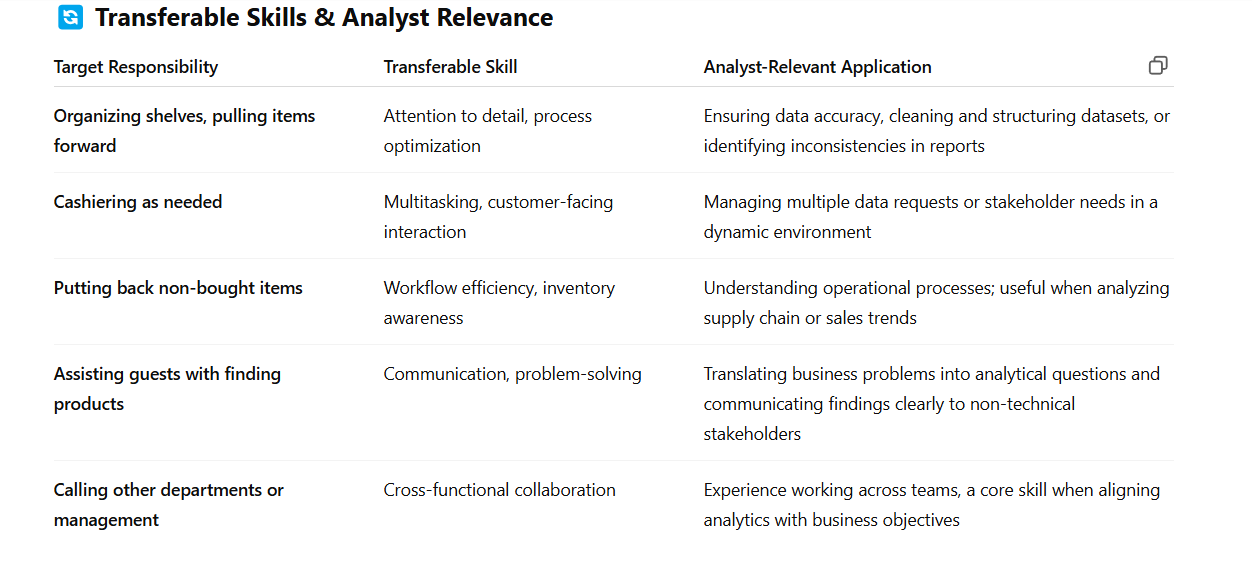
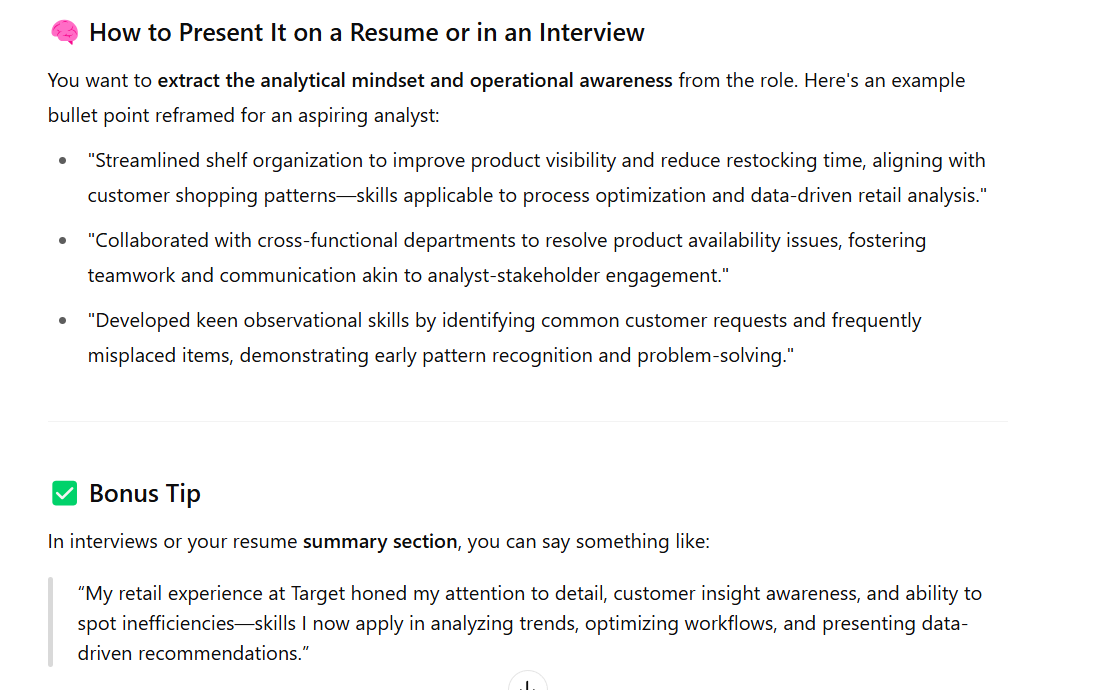
Here is an example of workflow efficiency:
Often times, I would be in charge of organizing the toy, sporting goods, and furniture departments. If my shift started at 6:00 pm and I’ve got 4 hours to make the shelves look presentable, I’m not going to be starting with the toy department knowing that from 6:00 pm to around 8:00 pm there are going to be lots of kids playing with the toys and moving things all around. I would only end up having to reorganize everything again at the end of my shift losing perhaps an hour or more. Instead, I would start with the furniture department, then move to sporting goods and then finish up with toys last. As for cashiering, I would answer to requests when they called all available sales floor personnel to cashier, but I also knew not to be volunteering all the time as I had to see how far along I was in my assigned departments. Often times, I would not complete organizing all assigned department depending on how busy we were with assisting guests. Assisting guests was our number one assigned priority over all other tasks.
Next role:
Personal Trainer at 24 Hour Fitness May 2018 - February 2019
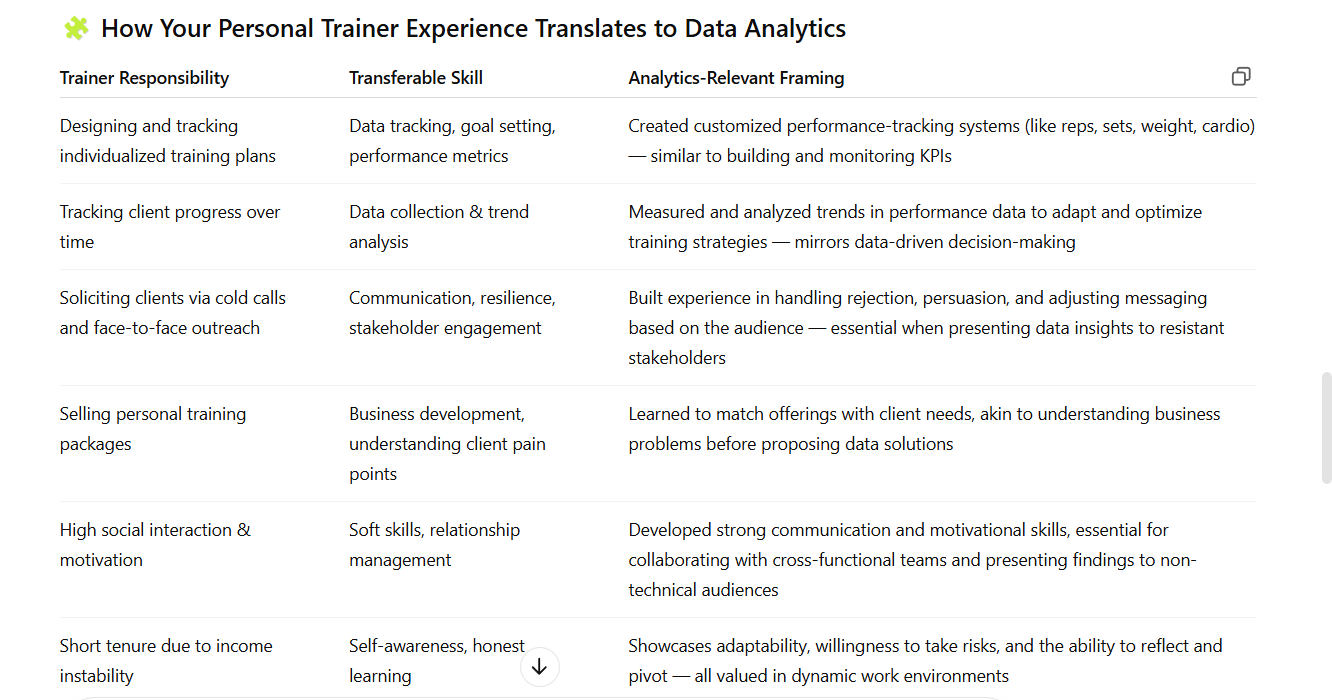
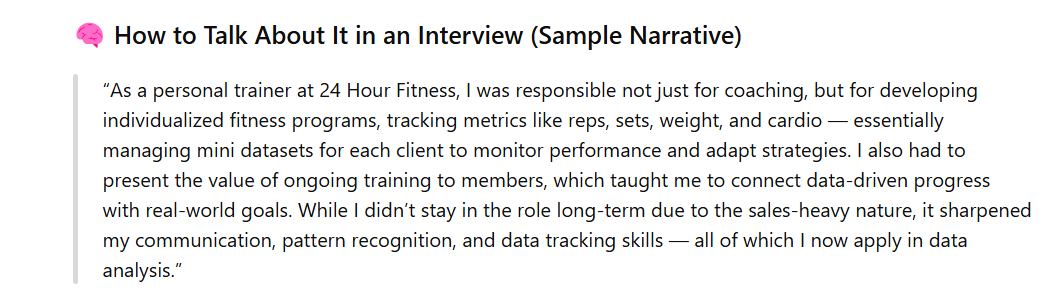
Considering that my master’s degree was in exercise science, there is that possibility I may have to fall back on to finding a job at a gym until I finally do land my analytics role. One things this response highlights as that personal training can involve a lot of tracking of fitness metrics which translates well into data analytics. Especially if one has a lot of clients, it can turn into a huge dataset. The results of keeping track of various metrics can help to determine which exercises are best given a person’s goals, age, health, and other factors. One can discover that maybe certain exercises are more conducive to helping someone run a faster 5k along with a structured running schedule. Then there is the interpersonal aspect of training to find out things such as stress, diet, and other information the client gives could be positively or negatively impacting gains.
 How to Frame on a Resume (Analytics-Oriented Bullets)
24 Hour Fitness – Personal Trainer
May 2018 – February
- Developed and maintained individualized performance tracking logs for clients using metrics such as reps, sets, weight progression, and cardio output
- Analyzed client data to optimize workout programs, demonstrating early use of data-driven decision-making
- Engaged in prospect outreach and sales conversations, improving stakeholder communication and persuasive presentation skills
- Coordinated with clients to set SMART goals, monitor weekly progress, and adjust training based on trends in client performance